

Few modern shows have inspired the kind of emotional attachment, theorizing, and cultural persistence that Stranger Things has. It is the kind of series people argue about passionately years after first watching, not because of plot twists alone, but because of how it made them feel at different stages of their lives. Some viewers connect instantly. Others drift away as it evolves. Understanding why the show resonated requires looking past monsters and mysteries and toward the emotional contract it offers its audience, and what kind of viewer that contract ultimately serves.
Why This Show Feels Bigger Than Its Story
Stranger Things arrived as a genre series, but it quickly became something closer to a shared emotional reference point. It blended familiar influences with a sense of sincerity that felt increasingly rare in prestige television. For some viewers, it was comforting. For others, it felt manipulative or overly sentimental. The divide is not accidental. The show is built around strong emotional signals, clear moral centers, and a deliberate nostalgia framework that shapes how its story is received. Examining why Stranger Things resonated means examining how it balances fear and warmth, innocence and loss, and spectacle with emotional safety.

What Stranger Things Is Really About Beneath the Sci-Fi
At its core, Stranger Things is not primarily about supernatural threats or secret experiments. It is about childhood as a fragile, fleeting state and the fear of losing it too early. The Upside Down functions less as a puzzle box and more as a metaphor for trauma, grief, and the unseen dangers that children are rarely equipped to process.
The series consistently returns to the idea that love and loyalty are not abstract virtues but active forces. Characters survive not because they are clever, but because they care deeply and refuse to abandon one another. This emotional engine is what anchors the show, even when its mythology becomes more complex. Beneath the horror aesthetics, Stranger Things is a story about holding onto connection in moments of fear, and about how loss permanently reshapes those who experience it.
Character Design and Emotional Arcs That Invite Attachment
Eleven and the Cost of Power
Eleven is the emotional fulcrum of Stranger Things. Her arc is not about mastering abilities but about reclaiming agency and identity after profound exploitation. The show invites viewers to see her power as both a gift and a burden. Her emotional vulnerability, limited language, and search for belonging make her power feel earned rather than aspirational.
What resonates is not her strength, but her confusion. The series allows her growth to be uneven and emotionally messy, which mirrors the way trauma actually unfolds. For some viewers, later seasons feel repetitive in revisiting her pain. For others, that repetition reflects the reality of healing rather than a narrative flaw.
Mike, Dustin, and the Fragility of Growing Up
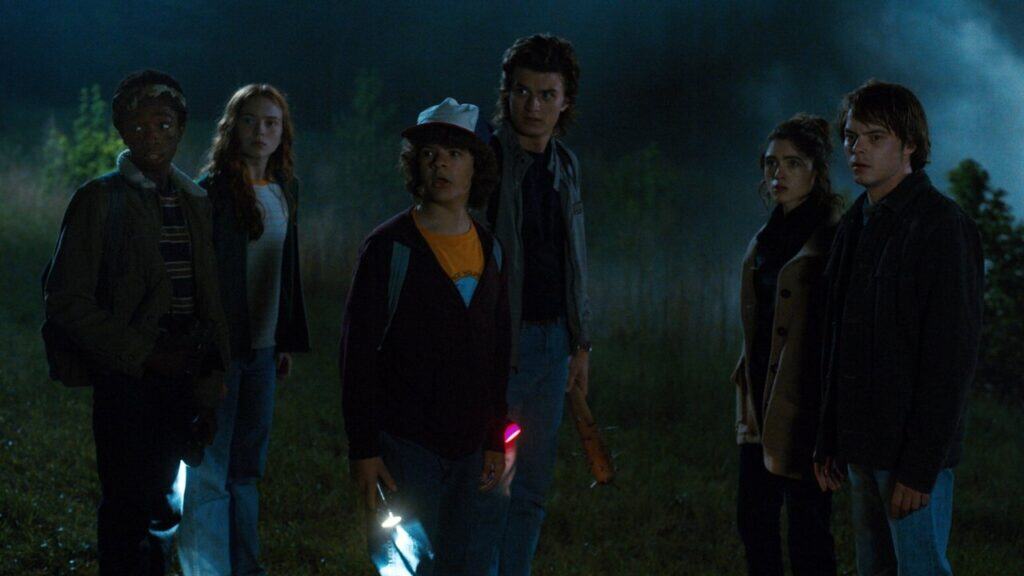
The original core group represents different responses to growing up. Mike clings to emotional intensity and loyalty. Dustin navigates fear with humor and curiosity. Lucas wrestles with skepticism and responsibility. Their arcs are intentionally modest. The show does not rush them toward maturity, which makes their emotional beats feel grounded.
This restraint is part of why the early seasons resonated so strongly. The characters are allowed to be children in ways that feel authentic, even as extraordinary events surround them. Later seasons test this balance as the characters age, leading to mixed responses from viewers who connected most strongly with the show’s initial emotional register.
Hopper and Adult Grief
Jim Hopper embodies the adult counterpart to the show’s central themes. His grief is not subtle, and the show does not attempt to make it elegant. His arc explores how unresolved loss can distort protection into control and love into fear. Hopper resonates because he is flawed in ways that feel recognizably human. His relationship with Eleven reframes masculinity around care rather than dominance, a choice that contributed to the show’s broader emotional appeal.
How Tone, Pacing, and Structure Shape the Experience
Stranger Things is carefully structured to balance tension with reassurance. Episodes rarely end without some emotional anchor, whether it is humor, warmth, or reunion. This rhythm creates a sense of safety even during frightening sequences. Viewers know the show will not abandon its characters emotionally, even if it places them in danger.
The pacing favors momentum over ambiguity. Mysteries are introduced clearly, escalated efficiently, and resolved within seasonal arcs. This structure supports binge viewing and emotional immersion but limits interpretive openness. Some viewers appreciate the clarity. Others find it reduces long-term suspense. The tonal consistency, especially in early seasons, makes the show accessible across age groups, which amplified its cultural reach.
What Stranger Things Gets Right Emotionally and Creatively
One of the show’s greatest strengths is its sincerity. Stranger Things commits fully to its emotional stakes without irony. Its musical cues, visual framing, and dialogue are designed to elicit feeling rather than distance. In an era of self-aware television, this earnestness felt refreshing.
The show also excels at ensemble storytelling. Characters are given space to interact in small, human moments that ground the larger narrative. These scenes often linger longer than necessary for plot, which allows viewers to build attachment. This approach aligns with ideas explored in [this analysis of character-driven genre storytelling], where emotional investment outweighs narrative complexity.
Where Stranger Things Divides Its Audience
As the series progresses, its reliance on familiar emotional beats becomes more pronounced. Some viewers feel the show repeats its arcs, particularly around separation, sacrifice, and reunion. The escalation of spectacle can also overshadow quieter moments, shifting the tone closer to blockbuster entertainment than intimate drama.
The nostalgia framework, while initially powerful, can begin to feel restrictive. References that once felt organic may appear increasingly performative. For viewers less connected to the era being referenced, this can create emotional distance. These tensions mirror broader debates discussed in [our breakdown of similar shows] that rely heavily on cultural memory as an emotional shortcut.
Why Stranger Things Connected at the Right Cultural Moment
Stranger Things premiered during a period marked by political anxiety, cultural fragmentation, and rapid technological change. Its depiction of community, loyalty, and clear moral boundaries offered emotional relief. The show’s portrayal of childhood friendships as sacred and resilient resonated with viewers seeking stability and connection.
Netflix’s platform amplified this effect. The binge model allowed audiences to immerse themselves fully, creating shared cultural moments almost overnight. Fan theories, soundtrack revivals, and social media discourse transformed the show into a communal experience. The emotional clarity of Stranger Things made it particularly well suited to this environment, as explored further in [this analysis of related themes].

Contextual Comparisons That Clarify Its Appeal
Stranger Things occupies a space between horror, coming-of-age drama, and family adventure. Compared to shows like Dark, it favors emotional accessibility over narrative complexity. Compared to The X-Files, it centers relationships rather than procedural mystery. Compared to It-inspired adaptations, it prioritizes warmth alongside fear. These comparisons help explain why Stranger Things reached a broader audience without needing to be narratively radical.
Longevity and the Experience of Rewatching
Revisiting Stranger Things often shifts perspective. Early seasons may feel more intimate in hindsight, while later ones emphasize scale and consequence. Rewatching highlights how carefully emotional beats were planted from the beginning, particularly in character relationships.
For some viewers, familiarity softens the impact of the show’s mysteries. For others, it deepens appreciation for its emotional consistency. The series rewards attention to character dynamics more than plot mechanics, which shapes its long-term appeal in ways discussed in [our long-form look at rewatchable series].
What the Resonance Ultimately Comes Down To
Stranger Things resonated because it understood that fear is most powerful when paired with care. It offered viewers a world where danger was real but connection was stronger, and where growing up was portrayed as both inevitable and deeply painful. The show does not ask whether viewers like its monsters or mysteries, but whether they are willing to invest emotionally in its vision of loyalty, loss, and love. If that emotional framework aligns with what a viewer seeks, the connection feels natural. If not, the distance becomes just as clear.