


Why So Many People Feel Unsure About Wednesday
Wednesday arrived with a strange kind of cultural pressure attached to it. It was instantly visible, instantly memed, and instantly debated. For some viewers, that level of attention creates curiosity. For others, it triggers skepticism. A show that looks this stylized and this popular can feel like it might be hiding something shallow underneath the aesthetic.
The uncertainty usually is not about quality alone. It is about alignment. Viewers are quietly asking whether Wednesday is a moody character study, a teen mystery, a gothic comfort watch, or something else entirely. The decision is less about whether the show is good and more about whether it fits how someone actually likes to watch television.

Framing the Question of Whether Wednesday Is Worth Watching
Asking whether Wednesday is worth watching sounds simple, but it rarely is. The show lives at the intersection of genres, tones, and audience expectations. It borrows from mystery, coming of age drama, supernatural fantasy, and stylized comedy. Depending on which of those elements you value most, the experience can feel either absorbing or oddly distant.
This makes Wednesday a show where reactions tend to say more about the viewer than the series itself. Some people settle into it quickly. Others never quite find the rhythm. A useful way to approach it is not by asking whether it succeeds universally, but by examining how it functions emotionally and structurally, and what kind of viewing habits it rewards.
What Wednesday Is Actually Trying to Do
A Character First, Plot Second Approach
At its core, Wednesday is not primarily interested in plot mechanics. The mystery and supernatural elements exist, but they are not the engine. The show is centered on its title character and the act of placing her in environments that resist her worldview. The story is built around contrast, not escalation.
Wednesday Addams is defined by detachment, control, and a refusal to perform likability. The show’s creative intent is to test that posture over time, not to dismantle it entirely, but to put pressure on it. The narrative often bends around her perspective rather than forcing her to conform to traditional emotional beats.
Emotional Reserve as a Theme
Beneath the gothic visuals and heightened performances, Wednesday is about emotional restraint. It explores what happens when someone who relies on distance as protection is required to engage with others in ways that cannot be fully controlled. The show prioritizes internal resistance over outward transformation.
That choice shapes everything from dialogue to pacing. Emotional moments tend to arrive obliquely, through implication or interruption, rather than through cathartic release. Viewers expecting big emotional swings may find this frustrating. Viewers who enjoy slow shifts in emotional posture may find it compelling.
How the Show Feels to Watch
A Consistent but Narrow Emotional Band
Watching Wednesday feels steady, controlled, and deliberately limited in emotional range. The tone rarely breaks from its cool, ironic register. Humor is dry and often underplayed. Suspense is present but rarely overwhelming. The show does not rush to provoke big reactions.
This consistency can feel comforting or monotonous depending on your tolerance for tonal variation. Episodes tend to move at a measured pace, allowing atmosphere and character interaction to carry scenes rather than plot urgency.
The Kind of Attention It Rewards
Wednesday rewards viewers who enjoy watching patterns develop over time. Small shifts in relationships, recurring visual motifs, and subtle changes in behavior are where the show does most of its work. It is not a series that demands full emotional immersion in every moment, but it does ask for attentiveness.
If you watch casually, it can feel thin. If you watch with patience, it often feels intentional. The pleasure comes less from what happens and more from how consistently the show commits to its mood and point of view.
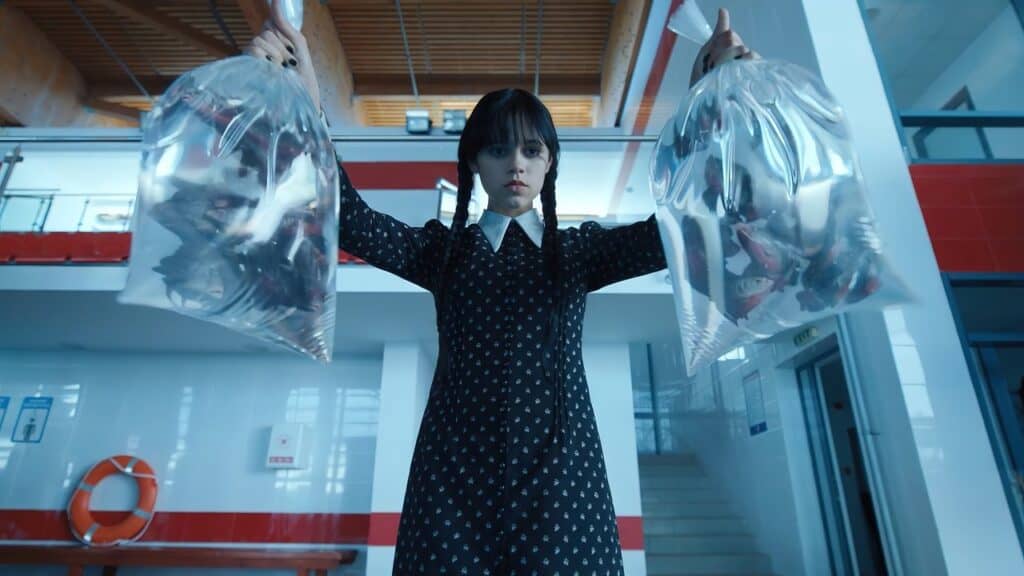
Strengths That Make Wednesday Worth Considering
Jenna Ortega’s Controlled Central Performance
The show stands or falls on its lead performance, and Jenna Ortega carries the role with remarkable discipline. Her portrayal of Wednesday is not designed to invite immediate empathy. Instead, it relies on precision. Small changes in posture, timing, and vocal emphasis do a lot of emotional work.
For the right viewer, this restraint is engaging. Ortega allows the audience to observe rather than be instructed on how to feel. That choice reinforces the show’s broader themes of emotional distance and control.
Visual Worldbuilding That Feels Purposeful
Wednesday’s visual design is not just aesthetic. The gothic architecture, costuming, and color palette all reinforce the character’s internal state. The world often feels slightly heightened, but never arbitrary.
This coherence helps ground the show even when its narrative choices feel light. The setting provides a sense of identity and continuity that makes the viewing experience feel deliberate rather than scattered.
A Clear Commitment to Tone
One of Wednesday’s strongest qualities is its refusal to chase tonal flexibility. It does not attempt to be everything at once. The show knows the mood it wants to maintain and rarely compromises it for easy emotional payoffs.
For viewers who value tonal integrity, this is a strength. The series feels confident in its pacing and emotional distance, even when that means certain moments land quietly rather than dramatically.
An Approach That Trusts Viewer Interpretation
Wednesday often leaves emotional conclusions unstated. Relationships evolve without overt commentary. Conflicts resolve without dramatic speeches. This approach can feel understated, but it also respects the audience’s ability to read between the lines.
Viewers who enjoy drawing their own conclusions rather than being guided toward a reaction may find this aspect especially satisfying.
Friction Points That May Turn Viewers Away
A Mystery That Feels Secondary
While the show includes mystery elements, they rarely feel urgent. The structure does not build tension in a traditional way. Clues exist, but they often feel like background texture rather than driving forces.
For viewers who approach the series expecting a tightly plotted mystery, this can be disappointing. The show is more interested in atmosphere and character positioning than in puzzle solving.
Emotional Distance That Can Feel Limiting
Wednesday’s emotional restraint is intentional, but it is also a barrier. The show rarely invites viewers to feel deeply alongside the characters. Instead, it positions them as observers.
Some viewers may interpret this as depth. Others may experience it as emotional flatness. If you need frequent emotional access points to stay engaged, the series may feel withholding.
Pacing That Assumes Patience
The measured pace works in service of tone, but it can test attention. Episodes often linger in scenes that establish mood rather than advance plot. Without a strong connection to the central character, this pacing can feel slow.
This matters because the show does not frequently compensate with high stakes or dramatic escalation. The reward is cumulative, not immediate.
Who Wednesday Tends to Work Best For
Wednesday works best for viewers who enjoy character driven storytelling where internal consistency matters more than narrative momentum. If you like shows that commit to a specific emotional register and stay there, this series aligns well with that preference.
It also suits viewers who appreciate style as a form of storytelling rather than decoration. The visual language is part of the narrative, not an accessory. If you notice and enjoy how setting and tone influence character behavior, Wednesday offers plenty to engage with.
Finally, it works for viewers who are comfortable with emotional ambiguity. The show rarely tells you how to feel. If you enjoy forming your own interpretations and sitting with unresolved tension, Wednesday can be quietly rewarding.
Who May Want to Pass
Viewers who prioritize plot intensity and narrative efficiency may struggle with Wednesday. If you want each episode to feel like it is pushing the story forward in a clear and urgent way, the series may feel underpowered.
It may also not align with viewers who seek emotional warmth or frequent catharsis. The show keeps its emotional distance by design. That choice will feel intentional to some and alienating to others.
If your enjoyment of television depends on rapid tonal shifts, high stakes, or overt emotional payoff, Wednesday may feel too controlled to fully satisfy.

Contextual Comparisons That Clarify Expectations
Wednesday shares tonal DNA with shows like Chilling Adventures of Sabrina, though it is more restrained and less emotionally volatile. Where Sabrina leans into heightened drama, Wednesday prefers controlled irony.
It also echoes aspects of The Queen’s Gambit in its focus on an isolated protagonist navigating institutional environments, though Wednesday is far less interested in psychological intensity and more focused on stylistic consistency.
There are also traces of Riverdale’s aesthetic ambition, but without the narrative excess. Wednesday uses style to reinforce character rather than to constantly reinvent its identity.
These comparisons are useful not because Wednesday replicates these shows, but because they help clarify what kind of viewing experience it aims to offer.
So, Is Wednesday Worth Watching?
Wednesday is worth watching if you are drawn to shows that prioritize mood, character presence, and tonal consistency over plot propulsion. It works best when approached as a controlled character study rather than a mystery driven binge.
It is worth your time if you enjoy performances that reveal themselves gradually, visual storytelling that reinforces emotional themes, and narratives that trust you to interpret rather than instruct.
It may not be worth it if you want high emotional engagement from the start, fast moving stakes, or a story that clearly signals its emotional beats. The show asks for patience and rewards alignment more than persistence.
A Final Thought Before You Decide
Deciding whether Wednesday is worth watching ultimately comes down to how you like to feel while watching television. This is a show that values restraint, atmosphere, and internal tension. It does not rush to win you over, and it does not try to be universally accessible.
If that sounds like a viewing experience you enjoy, Wednesday offers a confident and carefully constructed world to spend time in. If it does not, passing on it is less a judgment of quality and more a recognition of fit. Either choice is valid, as long as it matches how you actually like to watch.