
This list is for viewers who want the original era, not a modern remix. If what you miss is the specific rhythm of 90s and early 2000s television, this is where to start. When people search for Shows Like Friends From the 90s and 2000s, they are not just chasing a group of funny characters.
They are looking for a time capsule. That stretch of TV history had its own rules. Episodes stood on their own. Hangout scenes mattered as much as plot. Characters felt like people you could drop in on at any moment, even if you missed a week. That era is trending again because rewatch culture rewards shows that are easy to enter and easy to live with. You do not need a recap. You just press play.
The craving here is specific. Viewers want the pacing that lets jokes breathe, the chemistry that builds slowly over seasons, and the comfort of familiar spaces that never change too much. These shows were designed to be watched out of order, rerun endlessly, and quoted with friends the next day.
Tone and structure matter more than anything else. These series rely on ensemble balance, clean setups, and emotional payoffs that land without long arcs or heavy continuity. Many of these shows are easy to find across major streaming platforms, which makes revisiting them even simpler.
Below you will find three must-watch picks that truly match this era, three popular recommendations that often disappoint when compared directly, and ten more quick options that stay firmly within the same time frame.
3 Shows to Watch
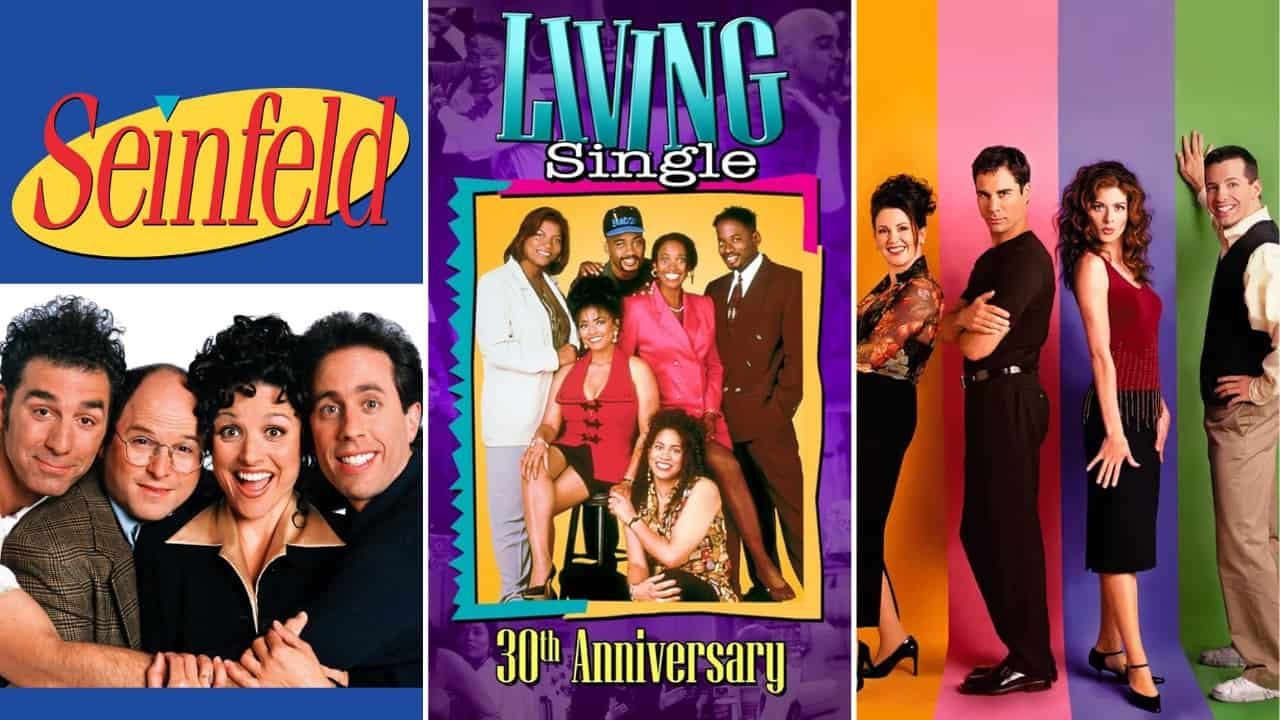
1. Seinfeld
Seinfeld is the purest snapshot of 90s television rhythm, and that is exactly why it belongs here. The show moves with a confidence that only existed in that era. Episodes start with small, everyday problems and spiral outward, connecting storylines that crash together at the last possible moment. Nothing feels rushed. Nothing feels padded. Each episode knows exactly how long it needs.
What makes Seinfeld stand out as a companion to Friends is not warmth but structure. Both shows center on a tight group that treats shared spaces like a second home. Conversations unfold in living rooms, diners, and familiar streets. The comedy lives in timing and delivery rather than spectacle. You are not watching big events. You are watching people react to life.
Character chemistry is the engine. Jerry, Elaine, George, and Kramer are sharply defined, but they only work because of how they bounce off each other. Every character has a role in the rhythm of a scene. The pauses, the interruptions, the side comments all feel deliberate. This is the same ensemble balance that made Friends work so well during its peak years.
Emotionally, Seinfeld offers payoff through recognition. You see yourself in the petty frustrations, the social missteps, and the tiny victories. The show trusts the audience to keep up without explanation, a hallmark of 90s storytelling. It does not reset characters every episode, but it also does not demand long-term memory.
Perfect For: Viewers who want classic 90s pacing, sharp ensemble timing, and episodes that reward attention without requiring commitment.
2. Living Single
Living Single sits right in the same cultural lane as Friends, and in many ways defines it. The show centers on a group of friends navigating careers, relationships, and adulthood, all within a consistent set of shared spaces. The structure feels instantly familiar if you grew up watching network sitcoms in the 90s.
What makes Living Single one of the strongest examples of this era is how naturally the chemistry unfolds. Characters overlap, interrupt, and support each other in ways that feel lived in. Scenes are allowed to breathe. Conversations are the point, not just the setup for jokes. The pacing allows personalities to shine without forcing constant punchlines.
The emotional payoff comes from balance. Episodes deliver humor, but they also give characters room to react honestly to change. Career shifts, romantic setbacks, and personal wins are treated as part of everyday life, not as season-long events. That restraint is key to why the show still feels comfortable to watch.
Structurally, Living Single reflects a time when sitcoms trusted consistency. Sets remain familiar. Relationships evolve slowly. The audience builds attachment over repetition rather than escalation. That approach mirrors what made Friends so rewatchable during its original run.
Perfect For: Viewers who want ensemble chemistry, familiar hangout spaces, and a 90s sitcom structure that values character over plot twists.
3. Will & Grace
Will & Grace captures the transition from late 90s to early 2000s without losing the classic sitcom core. The show thrives on sharp dialogue, clear character roles, and scenes built around interaction rather than action. Apartments, offices, and recurring locations anchor the storytelling.
What connects Will & Grace to Friends is the emphasis on chosen family. Characters move through life together, sharing daily routines and emotional beats. Episodes focus on how personalities clash and align, not on high-concept premises. The humor lands because the audience understands each character’s rhythm.
Pacing is a major strength. Episodes are tightly constructed, but never feel rushed. Jokes stack on top of each other through conversation rather than quick cuts. The structure reflects a time when sitcoms expected viewers to settle in rather than multitask.
Emotionally, the show balances humor with sincerity. Moments of vulnerability arrive naturally, then fade back into comedy without overstaying their welcome. That emotional rhythm mirrors what made Friends resonate across such a wide audience.
Perfect For: Viewers who want late 90s energy, strong character dynamics, and sitcom storytelling built on dialogue and timing.
Shows Like How I Met Your Mother is for viewers who want a more serialized group dynamic and long-term storytelling after exploring the classic network era.
3 Shows You Should Skip
1. How I Met Your Mother
How I Met Your Mother is often recommended to Friends fans, and the surface similarities are obvious. A group of friends. A city backdrop. Humor built around relationships and shared history. Expectations are high because the setup feels familiar.
The difference shows up quickly when you focus on structure. This series leans heavily into long-running arcs, callbacks, and future payoffs. Episodes are rarely designed to stand alone. The viewing experience depends on momentum rather than comfort. That places it firmly outside the 90s and early 2000s rhythm.
Pacing is faster and more self-aware. Jokes reference past episodes constantly, which can be fun, but it changes how the show feels when watched casually. Friends-era sitcoms assumed viewers might drop in at any time. This one rewards commitment instead.
Emotionally, the payoff is delayed. Instead of small, contained resolutions, the show builds toward larger conclusions. That approach works on its own terms, but it does not replicate the easy, repeatable experience people expect from this modifier.
Perfect For: Viewers who enjoy serialized storytelling and are planning a full watch from start to finish.
2. The Big Bang Theory
The Big Bang Theory shares an ensemble format and a multi-camera setup, which makes it seem like a natural match. It also dominated reruns, reinforcing the comparison for many viewers.
The key difference is era. The show is built for a later television environment, with faster joke density and a heavier reliance on punchline rhythm. Scenes move quickly, and character growth is often secondary to joke delivery. That shifts the experience away from the relaxed pacing of the 90s.
Character chemistry exists, but it functions differently. Interactions are designed around contrast and repetition rather than gradual evolution. Friends-era shows let relationships breathe. This one emphasizes consistent dynamics that rarely change.
While enjoyable, it does not capture the cultural or structural feel of the 90s and early 2000s sitcom landscape.
Perfect For: Viewers who prefer faster joke cycles and a more modern sitcom cadence.
3. New Girl
New Girl is frequently suggested because of its focus on friendship and shared living space. On paper, it looks like a perfect fit.
In practice, the storytelling style is distinctly modern. Single-camera pacing, heightened performances, and quick tonal shifts place it firmly in the 2010s. Episodes are built around energy rather than routine, which changes how the show feels when rewatched.
The ensemble chemistry is strong, but it plays out differently. Characters evolve rapidly, and the show often leans into exaggerated moments. Friends-era sitcoms stayed grounded in repetition and familiarity. That contrast becomes clear over time.
New Girl is enjoyable, but it does not replicate the era-specific experience this list targets.
Perfect For: Viewers who enjoy modern ensemble comedies with faster pacing and heightened performances.
10 More Shows That Fit This Vibe
-
Frasier: A character-driven sitcom that thrives on dialogue, timing, and long-running relationships rooted firmly in the 90s.
-
Everybody Loves Raymond: Classic network pacing with familiar settings and humor built around everyday routines.
-
That 70s Show: Ensemble storytelling with a consistent hangout space and era-specific rhythm.
-
The Nanny: A late 90s staple that balances character chemistry with episodic storytelling.
-
Just Shoot Me: Workplace-centered but structured with classic sitcom pacing and ensemble interaction.
-
Spin City: Fast dialogue within a traditional sitcom framework that reflects late 90s television.
-
Dharma & Greg: Relationship-focused episodes designed to stand alone and reward casual viewing.
-
Mad About You: Intimate, routine-driven storytelling that reflects early 90s sitcom structure.
-
Becker: Character-focused humor with a consistent setting and steady pacing.
-
NewsRadio: Ensemble comedy that thrives on interaction and contained episode plots.
Q & A
Are these shows meant to be watched in order?
Not really. Most were designed for casual viewing, where missing episodes does not break the experience.
Why does era matter so much here?
The 90s and early 2000s had specific pacing and structure that modern shows rarely replicate.
Are these shows still enjoyable for new viewers?
Yes. The storytelling relies on character and timing, which translates well across generations.
Do these shows rely on long story arcs?
Very little. Most episodes resolve within their runtime, making them easy to revisit.
Is laugh track style important to this list?
It is part of the era, but the key factor is how scenes unfold and how characters interact.
If you want something lighter that still works perfectly as background viewing, Netflix Sitcoms That Are Easy Background Watches is a great next stop for effortless picks.